

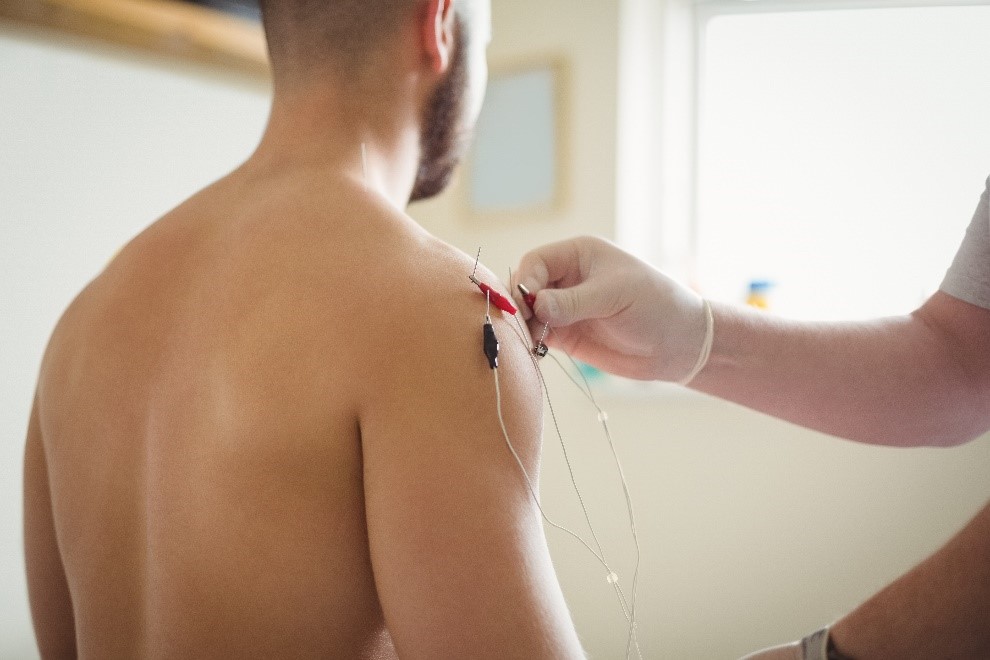
What is electroacupuncture?
Electroacupuncture applies a gentle, controlled electrical current to acupuncture needles after they’re placed at selected points. The current standardizes and often strengthens stimulation, aiming for a more consistent therapeutic effect.
What does the research suggest?
- Electroacupuncture has been studied across pain and non-pain indications (musculoskeletal, neurological, obstetric/gynecologic, gastrointestinal, and peri-operative contexts).
- The link between acupuncture and endogenous opioids is predominantly supported by electroacupuncture studies (more so than manual acupuncture).
- Findings include frequency-dependent activation of opioid mechanisms and reversal/attenuation by opioid antagonists in several models—supporting a genuine endogenous opioid contribution.
Main mechanism: endogenous opioids and frequency matters
- Lower frequencies (≈1–10 Hz) are repeatedly associated with supraspinal activation of β-endorphin/enkephalins.
- Higher frequencies (≈80–100 Hz and above) are more often linked with dynorphin activity at the spinal level.
- Alternating (dense–disperse) patterns (e.g., 2/15 Hz or 10/20 Hz) are used in research to engage multiple opioid pathways.
- In several experimental settings, naloxone/naltrexone (opioid antagonists) reduce or reverse electroacupuncture’s analgesic effects—evidence consistent with an opioid-mediated component.

Common clinical uses (as an adjunct)
- Musculoskeletal: low back/neck pain, osteoarthritis, frozen shoulder, myofascial pain
- Neurology: selected movement/peripheral nerve issues, headaches, some neuropathic pains
- Women’s health: pregnancy-related nausea (selected cases), labor-pain support (adjunct)
- GI & GU: nausea/vomiting, certain functional bowel/bladder problems
- Anesthesia & surgery: adjunct for intra- and postoperative pain control
Electroacupuncture complements—not replaces—standard medical care. Suitability is individual.
What to expect in a session
- Brief assessment and point selection
- Needle placement (very fine needles)
- Tailored electrical stimulation (perceived as gentle pulsing/tingling)
- 20–30 minutes per session; number of sessions depends on condition/response
Safety notes
- Usually mild, short-lived effects: local redness, soreness, or a heavy/aching sensation.
- Important precautions: pregnancy, cardiac pacemakers/implants, or specific medical conditions—discuss with your clinician.
- Single-use sterile needles and calibrated devices are essential.
Why clinicians choose electroacupuncture
- Precise dosing: control over intensity, frequency, and patterns (including dense–disperse)
- Mechanistic targeting: potential to bias different endogenous opioid circuits
- Durability (in some cases): combining needles with current may prolong benefits for certain patients
FAQ
Does it hurt? Usually a light tapping/tingling that most people tolerate well.
How many sessions? Condition-dependent; trends often emerge after a few sessions.
Medication conflicts? Typically, none, but disclose anticoagulants and key medicines.
Is it for everyone? Not always. A clinical evaluation is necessary.
